Posts

Showing posts with the label poverty and class

laundromats, underground libraries, and criminal charges: a library link round-up

Image
I have so many cool stories about libraries and librarians, scattered through multiple email and social media accounts. Lucky for you, I wanted to gather them all in one place. Thanks to everyone who ever sent me one of these. * * * * * Librarians in laundromats! Community librarians are all about taking literacy to the people. In library jargon, we're trying to reach the non-users. If that sounds a bit drug-dealer-ish, it's not a bad analogy: come get a taste, then come back for more. The puns just write themselves: front-loading literacy , unhampered access... but the issue is deadly serious. You already know about food deserts. Well, there are book deserts , too. Neighbourhoods where libraries have been de-funded, bookstores are nonexistent, and families can't afford to buy books. In the US, great swaths of whole cities are book deserts. After all, there's no profit in bringing books to people who can't buy them. * * * * * Librarians as detectives! Meet the squa...

from the 2018 cupe ontario library workers conference: libraries and the opioid crisis

Image
I recently attended the CUPE Ontario Library Workers Conference, which has become a highlight of my year since I first attended (and was elected to the organizing committee) in 2015. It has eclipsed and replaced the OLA Superconference as the most relevant and enjoyable must-attend conference in my schedule. When I first got my librarian degree, I was very excited about attending my first "OLA" (as it's always called). But I quickly learned that the sessions are a crap-shoot, sometimes relevant but often obvious and dull. There's also a great deal of boosterism by OLA and the member libraries. For the difference between the two conferences, for OLA, think employers and libraries , for CUPE Ontario, think  labour and library workers . In recent years, our Library Workers Conference has focused on precarious work and health and safety issues, two themes that are inextricably linked. This year's conference was called "Sex, Drugs & Bed Bugs," a light ...

required reading for revolutionaries: jane mcalevey and micah white

Image
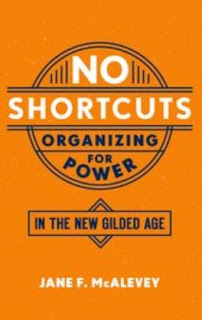
I've wanted to write about these two books for a long time, but adequately summarizing them is a daunting task. I just want to say to every activist and organizer: READ THESE BOOKS . I don't want to represent the authors' ideas, I want you to read them yourself . No Shortcuts: Organizing for Power in the New Gilded Age by Jane F. McAlevey and The End of Protest: A New Playbook for Revolution by Micah White are both aimed at activists and organizers -- people who already believe in the need for social change and are trying to influence the world in a progressive direction. Both books identify pitfalls and shortcomings in the current ways we approach our activism, and they offer concrete ideas for change, along with theory and philosophy to guide our decisions. Both are beautifully written, powerful, and essential. No Shortcuts  focuses on the labour movement, but McAlevey's analysis could apply to any movement. The labour movement is an excellent lens through which to...

what i'm reading: pit bull: the battle over an american icon

Image
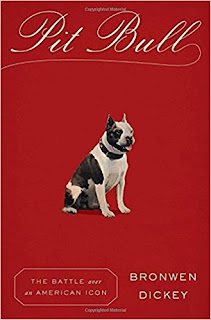
If you have an opinion about pitbulls, chances are good that it's based on myth, misinformation, and even disinformation. I know a good deal about dogs, and I thought  I knew a lot about pitbulls, yet I was constantly amazed and enlightened by Bronwen Dickey's Pit Bull: The Battle Over an American Icon . Here are some of the things you will learn if you read this book. There is no agreement on what a pitbull is . No one can correctly identify a dog's breed-mix based on the dog's appearance, including experts. Many or most media stories about pitbulls are based on uncorroborated heresay and myths, and many are actually fiction. Many dog-bite incidents reported as involving pitbulls actually involved Golden Retrievers, Dalmatians, Poodles, and other breeds. Accurate statistics about dog bites, especially those that account for severity, do not exist. There is nothing special about a pitbull's jaws or the strength of its bite. In fact, no test exists to measure the str...

what i'm reading: leaving lucy pear

Image
The year is 1917. A teenage girl from a wealthy family is pregnant, the result of rape -- by a man who her mother pushed her to pursue for marriage. Now the girl is being forced to surrender her baby to an orphanage. She has met the person who runs the orphanage, and she cannot bear the thought. The girl devises a plan, a way she can leave her infant daughter to be found by a large family who will, she hopes, raise her as their own. Ten years later, the lives of the woman who left the child and the woman who found the child intersect. But only one of them knows of their connection. Leaving Lucy Pear  by Anna Solomon begins with this tantalizing and emotionally charged premise, and as the story unfolds, it does not disappoint. Family secrets, desire, regrets, unintended consequences, and unfulfilled longing are set against a backdrop of Prohibition, labour justice, and classism. In the larger world, Sacco and Vanzetti are scheduled for execution, despite global protests.* The polit...

postscript: some clarifications and addenda to my recent post on cultural appropriation

Many people have been discussing my recent post about cultural appropriation  on Facebook. I'm not surprised that many people disagree (that's why I wrote it, to put my countering opinion out there), but I have been surprised by how many progressive people do agree. From the negative comments, I can see that I wasn't clear on a few important points. 1. The entire post refers to white , first-world people calling out other first-worlders with accusations of cultural appropriation -- not  aboriginal people. I would not pass judgment or venture an opinion about a native person's judgment of appropriation of their own culture. I have no right to do so -- and I would not do so. I was referring what I see as a quite a large bandwagon, pointing self-righteous fingers at others -- by white people, and at white people. 2. The above might explain why I feel the words shaming  and bullying  are fair game. I wasn't suggesting that aboriginal people are bullying white people abo...

accusations of cultural appropriation are a form of bullying -- and don't reduce racism

I'm increasingly dismayed by accusations of cultural appropriation that are used as weapons, rather than as a tool for raising awareness and educating. Accusations of appropriation have become a form of bullying, a weapon wielded to police and enforce a superficial obeisance to a behavioural code -- while doing nothing to address the underlying issues. Cultural appropriation is real. It's a valid issue. I'm not saying that cultural appropriation is not real. It is. I'm not saying claims of appropriation don't have merit. They do. When I was a child in the 1960s, parents might dress their children as "Indians" for Halloween, without a second thought. Kids played "Cowboys and Indians," dressing up in hats or feathers, with toy guns or tomahawks. Can you imagine if someone had played "Nazis and Jews"? It's completely inappropriate to turn a history of genocide and oppression into costumes and games. That in the 21st century, people are...

it's crunch time at the bargaining table

Image
Now here's an interesting calendar of events. June 27-29: The Negotiating Committee for CUPE Local 1989, Mississauga Library Workers Union, returns to the bargaining table for three days. June 30: The Negotiating Committee presents membership with a settlement offer. If the bargaining team recommends ratification, there is a ratification vote. If we do not recommend ratification, there is a strike vote. July 2: Summer programming begins at all our libraries. Free programs for children and youth attract a huge number of customers. July 4: The City of Mississauga and CUPE Local 1989 are in a legal or lockout position. July 7-8: The director of our library system hosts an annual conference of the Ontario Library Association. We played a long game of cat-and-mouse to make this timeline happen. It took a lot of resolve and a fair bit of luck. Now that we're here, perhaps our employer will be very motivated to avoid a strike. * * * * Brampton is a neighbouring city. Mississauga, Bram...

rtod: we only want the earth

On the 100th anniversary of the Easter Rising, these Revolutionary Thoughts of the Day are brought to you by the great Irish socialist, James Connolly. The day has passed for patching up the capitalist system; it must go. (1910) This speech, from 1897, is recreated in the excellent Ken Loach film "The Wind that Shakes the Barley": If you remove the English army tomorrow and hoist the green flag over Dublin Castle, unless you set about the organisation of the Socialist Republic your efforts would be in vain. England would still rule you. She would rule you through her capitalists, through her landlords, through her financiers, through the whole array of commercial and individualist institutions she has planted in this country and watered with the tears of our mothers and the blood of our martyrs. England would still rule you to your ruin, even while your lips offered hypocritical homage at the shrine of that freedom whose cause you had betrayed. Nationalism without Socialism –...

precariously yours: notes from the 2016 cupe ontario library workers conference

Image
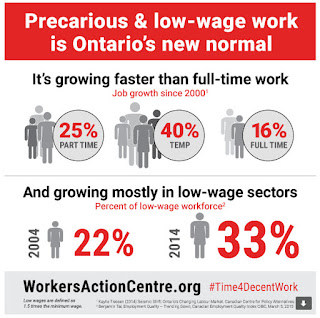
Last week I attended the CUPE Ontario Library Workers Conference, my second year, and my first since being elected to the organizing committee. This year's theme was precarious work , and nothing could be more relevant to library work today. All three keynote speakers were excellent, with engaging, eye-opening presentations that brought our picture into sharp and disturbing focus. Count it and name it, so we can change it Wayne Lewchuk , professor of economics and labour relations at McMaster University, is the go-to guy for research into precarious work. Michelynn Lafleche is the Director of Research, Public Policy and Evaluation at United Way Toronto. (United Way is the primary social-service provider in this region.) They developed PEPSO: Poverty and Employment Precarity in Southern Ontario . Its purpose: quantify the anecdotes, demonstrate what precarious work is and the affects it has on individuals, families, and communities, and offer practical solutions to this crisis. PEP...