Posts

Showing posts with the label peru

discoveries make me happy

Image
I am always astonished to see stories such as these. A tree-dwelling animal with a teddy-bear-like face and rust-coloured fur has become the newest mammal species discovered by scientists. The olinguito, the smallest known member of the raccoon family, lives in the cloud forests high in the Andes Mountains of Colombia and Ecuador, reported a team of scientists from the Smithsonian Institution in Washington, D.C., which described it in the journal ZooKeys Thursday. The animal has actually been displayed in museums and zoos over the past 100 years, but was mistakenly identified as a different, known species among its close relatives, the olingo. "It's been kind of hiding in plain sight for a long time," Kristofer Helgen, curator of mammals at the Smithsonian's National Museum of Natural History, and lead author of the new report, told The Associated Press. And this. Giant Maya Carvings Found in Guatemala Archaeologist Anya Shetler cleans an inscription below an ancient...
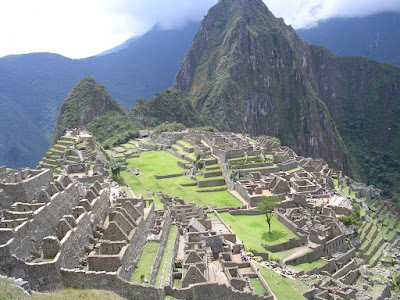
what i'm reading: cradle of gold, story of re-discovery of machu picchu

Image
One hundred years ago, this week - July 7, 1911 , to be exact - an American man named Hiram Bingham found the ruins of an ancient ceremonial city, mostly overgrown with Peruvian jungle. Some indigenous families were living on the site, tending small subsistence farms. Despite the fact that local people had always known about the ruins, and despite the fact that the clues of other explorers and many indigenous people enabled his route, Bingham claimed to "discover" these ruins. Those ruins are now one of the world's most famous and most remarkable places: Machu Picchu. Over the next few years, Bingham would bring Machu Picchu to the attention of the larger world. He would uncover other nearby Incan ruins and open the ancient paths between them, now known as the Inca Trail . He would also violate an agreement he made with the Peruvian government, and illegally excavate, remove and steal ancient artifacts from those sites, including the remains of Incan people - the ancestor...

the story of bottled water

I missed World Water Day , but this excellent video is relevant every day. From the good people who brought us The Story of Stuff , comes The Story of Bottled Water . We were in Peru in 2006. The water is not drinkable there, not for anyone for any reason. The very rich have filtration systems in their homes; everyone else boils water for a full 10 minutes before using it for anything. For tourists, which is a big chunk of the Peruvian economy, there is bottled water. Women sell it along the roadside, at train stations, in parking lots - everywhere there are tourists, there are women selling bottled water. They sell it cheap (by tourist standards) and cold. In many places where tourists are gathering, it's hot and very dry, and it's important to stay hydrated. You simply have no choice. You have to buy bottled water everywhere. And you can't refill the bottles, because you can't drink the tap water. And... plastic is not recycled. Only glass is recycled. We were there f...

peru sets example for u.s. citizens

You may have heard that, last week, the Supreme Court of Peru sentenced that country's former president, Alberto Fujimori, to 25 years in prison. That's hopeful, exciting - and enviable - news. Author James McEnteer offers his perspective about how Norteamericanos might learn from Peru's example. Peru's Supreme Court sentenced former Peruvian President Alberto Fujimori to twenty-five years in prison last week for creating death squads during his presidency - from 1990 to 2000 - which murdered dozens of people. More than seventy thousand people died during Fujimori's reign in the war between his iron-fisted administration and Maoist guerilla groups, the "Shining Path," and the "Tupac Amaru Revolutionary Movement." After a fifteen-month trial, the presiding judge, Cesar San Martin, said, "The charges have been proved beyond all reasonable doubt." The court found that Fujimori targeted various political opponents for kidnapping and assass...

1491: excerpts part 2

More from 1491 - New Revelations of the Americas Before Columbus by Charles C. Mann. Earlier posts here and here . In 1994 Ruth Shady Solis, of the National University of San Marcos in Lima, began working fourteen miles inland from Aspero, at a site known as Caral. From the sandy soil emerged an imposing, 150-acre array of earthworks: six large platform mounds, one sixty feet tall and five hundred feet on a side; two round, sunken ceremonial plazas; half a dozen complexes of mounds and platforms; big stone buildings with residential apartments. Haas and Creamer worked with the project in 2000 and helped establish Caral's antiquity: it was founded before 2600 B.C. While Shady continued work on Caral, Haas, Creamer, and Ruiz split off to investigate the Pitivilca, the next river to the north, and the Fortaleza, just north of the Pitivilca. They found, Haas told me, "major urban centers on a par with Caral in terms of monumental architecture, ceremonial structures, and resident...

1491: excerpts part 1

When I read a big, meaty book that excites me, I usually blog about it several times while I'm reading it. But for whatever reason, I found it difficult to write about 1491 , so I'm posting about it all at once. Here are some sections I tagged for future reference. * * * * Nobody knows how many died during the pandemics of the 1770s and 1780s, but even if one had a number it wouldn't begin to tally the impact. Disease turned whole societies to ash. Six Cree groups in western Canada disappeared after 1781; the Blackfoot nation, blasted by smallpox, sent peace emissaries to Shoshone bands, only to find that all had vanished. "The country to the south was empty and silent," Galloway wrote. So broken were the Omaha by disease that according to tradition they launched a deliberately suicidal attack against their enemies. Those who did not die quit their villages and became homeless wanderers. Cultures are like books, the anthropologist Claude Levi-Strauss once remarked...

what i'm reading: 1491

I recently finished 1491 - New Revelations of the Americas Before Columbus by Charles C. Mann, but I've been having a lot of trouble writing about it. It's sweeping in scope, packed with fascinating, interrelated information, beautifully written, but not easily summarized. I'll give it a shot, and I'll also post excerpts that I've scanned, to give you a feel for the writing and the ideas. Mann's basic premise is that the original peoples of the Americas were vastly more numerous, and their societies immensely more complex and advanced, than what most of us have been taught. There is also copious evidence to show that they were much older; there were advanced societies in this hemisphere for much longer than was previously believed. A flood of new evidence pertaining to the pre-contact Americas - meaning, the Americas before European settlement - has been discovered, discussed and often hotly debated during the past 25-50 years. But, Mann says, almost none of it...

thinking about water

Tony Clarke is the director of the Polaris Institute , the author of Inside The Bottle, an Exposé of the Bottled Water Industry , and a leader in the fight against the bottled-water industry - which means the fight for safe, publicly-available water worldwide. This week, he wrote this in the Toronto Star . Toronto's decision last week to ban the sale and distribution of bottled water on city premises was a watershed moment for water justice advocates the world over. What was truly significant about Toronto's action was not that it banned an environmentally destructive product, but that it included a commitment to ensuring access to tap water in all city facilities. Toronto is now the largest city in the world to pass such far-reaching regulations controlling the distribution of bottled water on municipal property and promoting the use of publicly delivered tap water. Other Canadian and American municipalities have enacted policies encouraging the consumption of tap water and l...

redsock link grab-bag # 2

This may become a semi-regular feature. To quote an earlier redsock link grab-bag : In an attempt to clear up a backlog of links hanging around my inbox, I forwarded the whole thing to Allan . . . who put together this grab-bag of links. Maybe you will find something useful or interesting among them. - L. * * * * Three Things To Remember When The US Government Says "Support The Troops". 1. In March 2008, the military changed its definition of combat-related disabilities - meaning that many injured veterans will not be eligible for benefits. Here are two examples of what the Pentagon says are non-combat-related injuries: Marine Cpl. James Dixon was wounded twice in Iraq - by a roadside bomb and a land mine. He suffered a traumatic brain injury, a concussion, a dislocated hip and hearing loss. He was diagnosed with post-traumatic stress disorder. Army Sgt. Lori Meshell shattered a hip and crushed her back and knees while diving for cover during a mortar attack in Iraq. She has...

uncontacted people seen in brazil, peru

An amazing story has emerged from South America. One of the world's few remaining uncontacted indigenous tribes has been photographed on the border between Brazil and Peru. Survival International , an international movement to support tribal peoples, says that more than half the world's remaining uncontacted tribes live in Brazil or Peru. The group's director, Stephen Corry, says such tribes will soon be wiped out if their land is not protected. The people revealed in these photos are at risk from illegal logging. Corry described the threats to such tribes and their land as "a monumental crime against the natural world" and "further testimony to the complete irrationality with which we, the 'civilised' ones, treat the world". The photos were first revealed by BBC News, but I thought the Globe and Mail did a better job with it today. Brazil's government agreed to release stunning photos of Amazon Indians firing arrows at an airplane so that...

mates burilados from huancayo, peru

Image
When we were in Peru in 2006 - actually on the last day of the trip - we met a young man from Huancayo named Cristian Alfaro Nùñez. He was selling the most amazing craft work we had seen in our three weeks in his country. The Nùñez family makes mates burilados , which translates literally as "engraved gourds". Here's what I wrote the day after we met him. In an alcove to the side of one of the exhibits, a young man sat in a room full of a kind of handicraft we have not seen anywhere else. He gave us a beautiful description (in Spanish, dumbed down for me, I believe) of how they are made and what they mean. They are gourds, meticulously engraved in the most painstaking detail, then rubbed with the black ash of a certain plant, then cleaned with another solution (all from plants found in the rainforest), so the inky colour stays only in the engravings. The drawings are playful and light, depicting festivals, music, work, family life, and other aspects of rural life in Peru...

follow-up: treasures of machu picchu still not in peru

In September, I blogged about a historic agreement, in which Yale University would return thousands of Inca relics excavated at Machu Picchu from 1911-1915 by Yale history professor Hiram Bingham. These include mummies, ceramics and bones. Some are museum-quality pieces, others are mainly of archaeological interest. But all belong to Peru. Peruvians - and Peruphiles, like me - were excited about the news. But so far, the agreement is just a piece of paper. Eliane Karp-Toledo, whose husband, Alejandro Toledo, is a former president of Peru, wrote this in the New York Times . Emphasis mine. Sure, it seemed like a great idea when, last September, President Alan García of Peru reached a preliminary agreement with Yale about the disposition of more than 350 artifacts taken from Machu Picchu. Everyone hoped the settlement might be a break for cultural understanding in the cloudy skies of international cooperation. News reports suggested that Yale would return more than 350 museum-quality a...

yale unversity to return treasures of machu picchu to peru

From BBC News, via AW1L: Yale University has agreed to return to Peru thousands of Inca relics that were excavated at Machu Picchu from 1911-15 by a history professor, Hiram Bingham. Peru demanded the artefacts back last year, saying it agreed to their removal on condition they would be returned. More than 4,000 pieces, including mummies, ceramics and bones were taken to the US university. Under the agreement Yale and Peru will co-sponsor the first travelling expedition of the collection. Yale will also act as an adviser for a new museum in the Andean city of Cuzco, close to Machu Picchu, where the exhibition will be installed after its tour. The museum's opening is planned to coincide with the centennial celebration of Bingham's rediscovery of Machu Picchu in 1911. During three trips to Machu Picchu, Bingham dug up thousands of objects, including silver statues, jewellery, musical instruments and human bones. The agreement between Peru and the Connecticut-based university cam...

i (finally) visit the rom

When my mom was here in early July, we were supposed to see "Ancient Peru Unearthed" at the ROM, but she had (and still has) an injured ankle, and we couldn't go. I went by myself yesterday, which is actually my favourite way to take in a museum. As you know, I loved the design of the new addition to the ROM, and felt Torontonian attitudes towards it were closed-minded and provincial - although less so than I thought . It wasn't that people didn't like it. It's that they seemed unwilling to consider it on its own terms. All I was hearing was a kind of "ewwww... it's different," a rejection of anything unusual, only because it's unusual. At that time, I hadn't yet seen the completed work in person, only in photographs. So here's my take. I love the way new building explodes out of the old one. I love the way the old and new are completely different, and don't appear to "go together," which is apparently a source of disc...