Posts

Showing posts with the label listening to joni

listening to joni: #12: dog eat dog

Image
Dog Eat Dog , 1985 Front Cover We've reached a milestone: a Joni Mitchell album I don't like. No, that's a cop out. It's not merely that I don't like Dog Eat Dog . It's that Dog Eat Dog is not good. It's a really bad album. All musicians, all artists, create clunkers sometimes -- especially if they're experimenting and expanding. Bob Dylan, Bruce Springsteen, Elvis Costello, Van Morrison, David Byrne -- musical giants all, and all have released albums that aren't very good. And although it pains me to write this, Joni is not the exception. I stopped reading David Yaffe's biography of Joni while I was writing this blog series, so I don't know the history behind Dog Eat Dog . (I will go back and finish the book.) I don't know if Joni was pressured to try a more commercial sound, or if she genuinely wanted this album to sound and feel the way it does, or if perhaps the final result didn't reflect her intentions. The overall effect is t...

listening to joni: #11: wild things run fast

Image
Wild Things Run Fast , 1982 Front Cover Wild Things Run Fast feels like the beginning of a new Joni era. Mingus ended a trajectory. After Mingus , Joni toured, and took a break from recording. From now on she would release an album every three or four years, rather than annually as she once did. For me, Wild Things is an easy album to enjoy. It's tuneful and accessible, Joni's voice velvety over well-honed pop-jazz. With the opening notes of the first track, "Chinese Cafe/Unchained Melody", you know you're in familiar territory, reminiscent of Hissing and Hejira , but simplified and streamlined. Back Cover I wonder if this lady has a hole in her stockings. "Chinese Cafe" laments lost youth, and the lost landmarks of youth, the paved-over paradise, not with a deep sadness, just a wistfulness, an acceptance. Joni sings to an old friend, as she did in "Song for Sharon". Careful listeners, hearing My child's a stranger, I bore her, but I co...

listening to joni: #10: mingus

Image
Mingus , 1979 Mingus is unique in Joni's work, in that she wrote lyrics to someone else's instrumental music. Four of the six tracks on Mingus were written collaboratively by Joni and Charles Mingus. Charles Mingus was a jazz composer and band leader. He was enormously influential, and anyone following contemporary jazz music would have known his work. But it's doubtful whether in 1979 most Joni Mitchell fans even knew his name, let alone recognized his music. In the late 1970s, Mingus had ALS and was failing physically. He reached out to Joni, and they began a long-distance friendship. After about a year, he asked Joni to write lyrics to a group of songs he had composed. The full story of how the collaboration began is more complex, but it wasn't known at the time. Mingus died before the album was finished, although he did hear finished versions of most of the songs. Mingus is another step on the jazz path Joni began with Court and Spark , and which became a greater...

listening to joni: #9: don juan's reckless daughter

Image
Don Juan's Reckless Daughter , 1977 I discovered I didn't own Don Juan's Reckless Daughter  either on LP or CD -- which means I don't know the music from it, except for anything performed live or on compilations. This means I have only my current opinions and impressions, and no earlier thoughts to compare them to. I can conjecture that I wouldn't have liked this album when it was released in 1977, or in 1987 for that matter, because I wouldn't have understood it. I hope by 1997, when I was beginning to explore jazz, I would have been ready to listen. It is jazz. And it is Joni. I like it a lot, and I can tell that repeated listenings will yield more meaning. On DJRD Joni works with a group of jazz artists, including four members of the Weather Report ensemble -- Jaco Pastorius (who was already Joni's friend and collaborator), Wayne Shorter, Manolo Badrena, and Alex Acuña. The first track, "Overture," is played on six guitars in different tunings ...

listening to joni: #8: hejira

Image
Hejira , 1976 Front Cover Photo by Norman Seeff; Frozen lake by Wisconsin. Hejira snuck up on me. I heard it was "wordy," "cold," and "cerebral" and that the music was "abstract". I didn't know what that meant, but it didn't seem good. On the radio station I listened to as a teenager, one of the last holdouts of independent rock radio, "Song for Sharon" had heavy rotation. That's no surprise, as it's a thoroughly New York City song. I would hear it in the background, when I was driving or doing homework, and catch bits of lyrics: Staten Island, skyline, Bleecker Street, " eighteen bucks went up in smoke ". Then there was a video. No idea how or where I saw that, as MTV was still several years in the future, but the video of "Amelia" caught my imagination. Amelia Earhart is a lifelong fascination of mine; even at that age, I had a crush on her. Now it seemed that Joni, fascination numero uno, was also...

listening to joni: #7: the hissing of summer lawns

Image
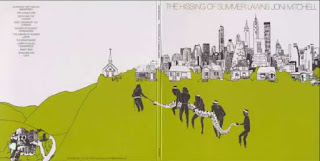
The Hissing of Summer Lawns , 1975 Front and back covers: The landscapes of the songs Joni's seventh studio album (her ninth album overall) is both a continuation and a departure.  The Hissing of Summer Lawns is rich and multi-layered, somewhat enigmatic, full of interesting images and sounds that are open to interpretation. When I'm in a certain mood, this becomes my favourite of all Joni's albums, surpassing even Court and Spark in my imagination, flooring me with its beauty and complexity. Musically, on this album Joni continues to bring more jazz arrangements to her songs. But she also begins something new: the music is used very sparingly, sometimes only for rhythm, while the melody is carried by only one instrument, Joni's voice. This is most pronounced in some of the album's most memorable numbers: "Edith and the Kingpin," "Don't Interrupt the Sorrow," "Shades of Scarlett Conquering," and "The Boho Dance". Listen ...

listening to joni: #6: court and spark

Image
Court and Spark , 1974 Writing about the music of Joni Mitchell has been a huge challenge. My love of music and my writing abilities seem to live in separate spheres: I write with my brain, but I listen with my heart. If writing about Joni's music has been challenging, writing about Court and Spark feels impossible. The love and connection I feel for this music is impossible to put into words. So with that disclaimer, I will now attempt the impossible. Court and Spark is many Joni fans' favourite album. I mentioned that fans over a certain age seem to choose Blue ; fans under that age, those younger than the boomer generation, seem to gravitate towards Court and Spark . Listening to this music in retrospect, you can follow the very clear musical progression from Blue  to For the Roses  to Court and Spark . But in its day, no one could have been prepared for this masterpiece. On Court and Spark , Joni more fully realizes many threads that emerged on previous albums. The...

listening to joni: #5: for the roses

Image
For The Roses , 1972 Front Cover For The Roses  is often overlooked, sandwiched as it is between two masterpieces. Fans who missed it might be surprised at its richness -- musically, lyrically, and emotionally. It has always been one of my favourites. For the Roses  sits between Blue and Court and Spark  not only chronologically, but musically. There are the rich, deep piano chords of Blue , but heralds of another sound are mixed in -- woodwinds, reeds, and strings, Joni's own multi-track backing vocals -- hints here and there of what would be developed so astonishingly on Court and Spark . Listening to this now, I realize that in the past, listening on LP, I must have strongly favoured side two, beginning with "See You Sometime" and closing with "Judgement of the Moon and Stars (Ludwig's Tune)". This re-listen was an opportunity for me to hear the first six songs with a fresh mind. The album opens with a political song, a song of social consciousness, whic...

listening to joni: #4: blue

Image
Blue , 1971 Front Cover The back cover is solid blue. Inside, only lyrics and credits. Ask people their favourite Joni Mitchell album, and you are very likely to hear Blue . In my experience, this is especially true of older fans who discovered the album in real time. Blue is a masterpiece; there is no doubt of that. It is also the masterpiece that is more straightforward and accessible. When a Joni fan names Blue as their favourite, I wonder if this was the last stop on her journey with Joni's music. That may not be fair, but my experience continues to reinforce the theory. In my post about Ladies of the Canyon , I wrote that in that album we hear foreshadowing of the future Joni. This is true. But after those first three albums, no one could have been prepared for Blue . With Blue , Joni rockets into an entirely different universe of talent. The music, lyrics, vocals, arrangements, the emotions and ideas expressed, are all light-years beyond what came before. Here Joni shows he...